
ALK Diagnosis
What are the symptoms of ALK?
In this video, Jennifer Yung, a respiratory physician, and Seamus Grundy, a consultant respiratory physician, discuss the symptoms of ALK-positive lung cancer.
The symptoms of ALK are very similar to symptoms of other lung cancers. Often lung cancer has no symptoms at all in its early stages.
Most of the symptoms of lung cancer are non-specific; that is, they are symptoms that can be caused by a number of different conditions. Some of the symptoms that can be experienced are:
The non-specific nature of symptoms makes it particularly difficult to diagnose lung cancer in never smokers. This is because it is much more common for these symptoms to be caused by a condition other than cancer.
What are the symptoms of metastatic ALK?
If the cancer has metastasised (spread) to other parts of the body, this may also cause symptoms. Areas that lung cancer can spread to, and examples of symptoms this might cause, include:
How is ALK diagnosed?
To give an example of the diagnostic process for lung cancer in general which can then lead to the identification of an ALK lung cancer, we will follow the diagnosis journey of a fictional person, Kim. It’s important to remember that every person is different, so the journey below will not be the same for everyone. Your healthcare team will plan the tests and treatments that are right for you as an individual.
Summary: the most common sequence of events with a new cancer diagnosis would be:

Duncan's diagnosis story
Play to hear Duncan’s experiences of being diagnosed with ALK-positive lung cancer.
How is ALK tested?
Testing for an ALK mutation is a two-stage process. First, a tissue sample is examined in the laboratory to confirm a diagnosis of lung cancer. If the sample is eligible for ALK testing, it then undergoes genomic testing and/or immunohistochemistry testing to check for an ALK mutation.
Step 1: Confirming a lung cancer diagnosis
A lung cancer diagnosis is confirmed via histopathology.
Step 2: Testing for an ALK mutation
There are several different ways in which we test for ALK: the tests which are done in the lab, and genomic (or molecular) testing. Click the circles in the timeline below to learn more about these tests.
What are the challenges when testing for an ALK mutation?
- ALK testing is a multi-step process that involves multiple sites and people. This multi-step process can lead to delays in treatment.
- Taking a lung cancer sample can be challenging as it is an invasive procedure. In many cases, the sample may be too small to analyse.
Why do the tests sometimes fail?
There are several reasons why tests can fail:
- The biggest issue is the small size of the tissue sample taken for testing. The sample is needed for multiple steps, such as processing, diagnosis and ALK testing, and there is sometimes not enough tissue for all the steps.
- There can be technical failures in the lab, for example during fixation of tissue and staining.
- In genomic testing, DNA needs to be extracted from the tissue sample. The quality of the DNA can sometimes be affected when the tissue is processed, which can cause the analysis to fail.
- Certain types of tissue, such as tissue taken from bone biopsy, are not reliable for DNA analysis.
How is the genomic testing organised?
How is the genomic testing organised
What are the different cancer stages?
The stage of a cancer is a description of how advanced it is; how big the cancer is and how far it has spread. Staging a cancer helps healthcare teams advise patients on which treatments should be considered and the overall prognosis.
Patients with ALK+ lung cancer will be staged using the same TNM staging system used for all non-small cell lung cancer. TNM stands for tumour, node and metastasis:
- Tumour (T) refers to the size of the primary tumour in the lung (the initial mass where the cancer started, and often the main largest mass).
- Node (N) refers to whether or not there is any cancer in the lymph nodes near the primary tumour.
- Metastasis (M) refers to whether or not the cancer has spread to any other more distant parts of the body (such as the bones or brain).
There are four cancer stages (1-4). These are often written in Roman numerals (for example, stage 4 may be written as ‘stage IV’).
At which stage are most lung cancers diagnosed?
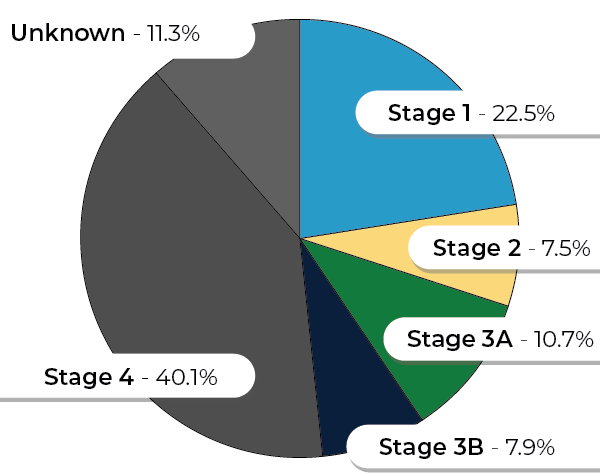
The percentages of non-small-cell lung cancers (NSCLCs) diagnosed at each stage at the time of presentation (in the UK) are shown in the chart.
It is important to note that the data above relates to all NSCLCs, rather than just to ALK. The percentage of people diagnosed at stage 4 who have ALK-positive lung cancer tends to be higher than in the general population with non-small-cell lung cancer.
There are several reasons for this:
- Many ALK patients are younger than the average person who has lung cancer.
- Many ALK patients are never- or light-smokers (which means these patients can also be excluded from screening programmes where available).
- The most common symptom is a cough which can be attributed to other benign causes such as infections.
These reasons lead to a low ‘index of suspicion’, both for the individuals and health care professionals.
What is the prognosis?
What is the prognosis?
In this video, consultant medical oncologist Fabio Gomes explains the prognosis for ALK.